All posts by pastorcbailey

Year of Scripture – Day 36

Leviticus 14 – Leviticus 15

I had to laugh as I read through these chapters, because an image popped into my head. As I sat reading, my mind began painting an interesting picture of what life might have sounded like as Ancient Israel was getting established. Here’s what I mean . . .

Leper’s, once outcast from the community, were required to call out, “Unclean! Unclean!” any time someone approached. What if every instance of uncleanliness that we have been reading about had the same requirement? Can you imagine constantly having to call out “Unclean! Unclean!”?

Ate something you weren’t supposed to . . . “Unclean! Unclean!”
Just had a baby . . . “Unclean! Unclean!”
Found mold in your house . . . “Unclean! Unclean!”
Got a scab . . . “Unclean! Unclean!”
Got a splinter . . . “Unclean! Unclean!”
Stubbed your toe . . . “Unclean! Unclean!”
Visited the funeral home . . . “Unclean! Unclean!”
On your monthly cycle . . . “Unclean! Unclean!”
Made love . . . “Unclean! Unclean!”
Had an ear infection . . . “Unclean! Unclean!”
Got a cold . . . “Unclean! Unclean!”
Just having a bad day . . . “Unclean! Unclean!”

Talk about a babbling bunch of fools! What an image! Now, please realize, most of these “unclean” moments didn’t require making it public knowledge, but what if it did? We’d all be walking around yelling at one another, “Unclean! Unclean!” I guess when you think of it this way, making a ritual sacrifice isn’t quite so bad!

Peace,
Pastor Bailey

Next reading: Leviticus 16 – 18

Year of Scripture – Day 35

Leviticus 11 – Leviticus 13

So much for enjoying lobster, crab, shrimp, bacon, and camel! Guess if we are going to live according to the Levitical Law, we’d have to strike all of those off of our favorite food list. Not that too many of us enjoy camel. Although, the last time I looked at a camel’s toe, I was pretty sure it had two parts. Add to that rock badger and bat, sounds like some pretty good eats to me???

Humor and diet aside, as we turn to these chapters in Leviticus we see that the ordinances of God now have a practical implication for the people. Essentially, God is saying, “If you are going to be my holy/chosen people . . . this is how you should live.” Then, God also recognizes that there will be times when we may find that we are less than holy, or to use better terms “unpure” or “unclean.” According to these chapters in Leviticus, we would become unclean when:

  • We touch something that has died.
  • We tough something that is designated as unclean.
  • We give birth.
  • We have a sore, blemish, or other type of rash/wound on our skin
  • And on the list could go, but we’d be getting into the next section to read (Leviticus 14 – 15).

As we read the list of ways to become “unclean”, notice that there isn’t penalty or death. God realizes that things happen. God than establishes a way for the people to restore the holy/clean nature God intended. This is done through the passage of time, bathing, sacrifice, or some combination of all the above. Very rarely did uncleanliness lead to banishment or death. Indeed God is gracious!

Lastly, as a pastor, I can’t help but think of the priest. Aaron and his sons, still newly ordained, now find that they are supposed to be: dietitians, OBGYNs, and dermatologists. I believe, if that were the case for me, I would be looking for a different calling.

Peace,
Pastor Bailey

Year of Scripture – Day 34

Leviticus 8 – Leviticus 10

There is joy! There is excitement! There is tragedy!

The day has come when Arron and his sons are ordained, consecrated, and set apart for their ministry to God and the oversight of the Tabernacle. It must have been an exciting day! It must have been a day full of great joy! This was a long awaited moment. With the tabernacle was complete, and with the priests soon to be ordained, there was a sense of stature and permanence for the people of Israel.

The anointing oil is poured! The bull is sacrificed! All is well! Almost! Tragedy soon strikes. Two of Aaron’s sons, (chapter 10) don’t quite follow the rules established by God on how things are supposed to be done in and around the Tabernacle. With that, they are consumed with the fire of the LORD. Wow! Perhaps that was unexpected. Perhaps that was a bit extreme. Perhaps that was a bit unjustified. Well, yes and no.

I will agree there isn’t much of a semblance of grace on this one. There isn’t even a chance for Aaron and his family to mourn as the orders are given, “do not dishevel our hair, and to not tear your vestments . . . you shall not go outside the entrance of the tent of meeting (to the burial site) . . . or you will die” (10:6-7). Again, all sounds a bit harsh. Yet, for us a readers, we’ve just journeyed through page after page with all of God’s how to’s in keeping the Tabernacle. God’s instructions are clear. We are supposed to follow them. At this point, as the priests are set apart, God shows that there are serious implications in not abiding by the Law.

What does that mean for you and me? Thanks be to God, it means that Jesus intercedes on our behalf, and despite our own imperfections, God shows us grace and mercy.

Peace,
Pastor Bailey

Our next reading: Leviticus 11 – 13

Year of Scripture – Day 33

Leviticus 5 – Leviticus 7

I don’t know about you, but I was glad to see that the gruesome nature and description of chapters 1 – 4 weren’t repeated in these next several chapters. One thing remain constant, the continued instruction on how the priest should offer various sacrifices for the different offerings. Even for the expert reader, it gets a bit confusing remembering the difference between these five different sacrifice/offering that God is asking the people to make. So here are a few pointers:

Burnt Offerings

The first and most common offering was the Burnt Offering, which was required as a general offering for the atonement of one’s sin and as an expression of devotion to God. The instructions for the Burnt Offering are given in Lev 1:3-17. The offering could be a bull (1:3), sheep or goat (1:10), or dove or pigeon (1:14). The animal was to be burnt whole overnight (6:8-13), though its skin was given to the priest (1:6).

Grain Offering

The second type of offering is the Grain Offering. This offering was given as an expression of devotion to God. It was voluntary and allowed people to acknowledge God’s goodness and providence. The instructions for the grain offerings are given in Leviticus 2. Most often, it was cooked bread—baked (2:4), grilled (2:5), fried (2:7), roasted, or made into cereal (2:14)—though always seasoned (2:13), unsweetened, and unleavened (2:11). Unlike the Burnt Offering, only a portion of the offering was to be burnt (2:9). The remainder went to the priests for their meal (2:10).

Peace Offering

The third offering is the Peace Offering, which includes Thanksgiving Offerings (Lev 7:12), Freewill Offerings (7:16), and Wave Offerings (7:30). These offering could be made with a male or female cattle (3:1), sheep (3:7), or a goat (3:12), as long as it was without blemish. Some Thanksgiving Offerings could also include a variety of breads (7:12). The purpose of making a Peace Offering was to celebrate the gathering of two or more parties, and to comment their relationship to God as they enjoy fellowship with one another. The portions unsuitable for eating were given to God (7:19-27). Depending on the type of Peace Offering, the breast may have been given to the High Priest (7:31) and the right thigh may be given to the priest officiating the meal (7:32). The rest of the meal was to be eaten within one day by the families making the offering (7:16). Also, take note, that all leftovers were to be burnt after two days (7:17).

Sin Offering

The fourth offering Sin Offering, which was given as a sacrifice for an unintentional sin (4:2-3, 4:20). Other times, these were given or called a guilt offering, to aid in removing the consequences for our lack of perfection (4:13-14, 4:22-23). As an atonement offering, it contained elements of a Burnt Offering (4:25), yet at the same time had elements of a Peace Offering (4:26). Conversely, some of the “sins” for which one needed atonement were not moral sins but rather matters of ritual impurity (5:1-5). For this reason, some may call these “Purification Offerings” instead of a “Sin Offering.” The primary purpose of this offering is not to atone for sins but rather to purify oneself for re-entering the presence of God. The elements of a Purification Offering could be any of the elements of the previous three types offerings, though unlike the Peace Offering, the meal was not to be shared by the one offering the sacrifice.

Guilt Offering

The fifth and final offering was the Guilt Offering. Unlike the English word “guilt” this does not refer to a matter of one’s conscience but rather to something one owes on account of a “sin.” Other suggestions for the name of this offering are the “Trespass Offering” or the “Reparation Offering.” The purpose of this offering was to make reparations for one’s sin. As such, this offering had a specific monetary value, and one who owed another on account of a debt due to a “sin” could repay it in silver rather than by sacrificing a ram (5:15). In addition, a 20% fee was assessed and given to the priest who mitigated the debt (5:16).

Hopefully this helped you to clarify the differences between one sin and the other. I know it certainly helped me. So many thanks to Jeremiah Garrett and his article on Seedbed.com for all your useful information!

The 5 Offerings in the Old Testament

Now on to see what our next reading has in store, as we read Leviticus 8-10.

Blessed Sunday!
Pastor Bailey

Year of Scripture – Day 32

Leviticus 1 – Leviticus 4

As we shift into a new book of the Bible, I did some quick reading on the history of Leviticus. Something I never recognized before . . . Leviticus, just the name itself . . . takes is meaning and roots from the Levites, which comes out of Levi, who was one of the sons of Jacob. If we remember correctly, it was the Levites who were appointed priest over the Tabernacle. So, connecting all the dots, this book is written for the priests, and we see that quite quickly as we dig into the first four chapters.

Other quick observations:

  • Yuck! Instructions for sacrifice after sacrifice. Everything described so beautifully in Exodus regarding the building of the Tabernacle, now covered in blood from sacrifice after sacrifice.
  • Can you imagine the smell? Blood dried, animals and bread on the open fire, and a cloud of incense constantly burning. Honestly, I can’t say if that would smell good or not.

All in all it makes me grateful that Jesus became the living sacrifice and that these duties aren’t part of my own pastoral responsibilities!

More to read as we take a look at Leviticus 5 – 7.

Peace,
Pastor Bailey

Year of Scripture – Days 30 – 31

Exodus 36 – Exodus 38
Exodus 39 – Exodus 40

Another book complete! Another month, come and gone! Now we are well on our way. Many say it takes 30 days to make something a habit, and since the first of the year, we’ve done just that. Nice work! A little bit of self praise is a good thing, and we might need that as we turn the page into Leviticus.

Before we do that, we realize that Exodus comes to a close with the building of the Tabernacle. Just as described in earlier chapters, the tent covers, lamp stand, curtains, various altars, and all the utensils needed are completed just as God had given direction. Moses even gives it his two thumbs up (39:43) before it was all constructed. Moses even gets that honor, throughout chapter 40 as everything is put in its proper place.

Then, when all is said and done, God descends in a “pillar of cloud”, and begins to dwell within the Holy Space. Oddly enough, as much as Moses has played a key role in building the Tabernacle, once the Cloud descends, Moses cannot enter. It’s implied, but not clearly stated, from this point on, the Tabernacle is reserved for the Priests (Arron and his sons) as God now finds a home with the people of Israel!

Tomorrow . . . new month . . . new book. On to Leviticus chapters 1 – 4.

Peace,
Pastor Bailey

Year of Scripture – Day 29

Exodus 33 – Exodus 35

Burr! It is cold out there! I hope everyone is staying warm on these very blustery winter days!

As we looked at today’s text, we might be feeling as if we are experiencing deja vu. Didn’t we read this already? Yes . . and . . . no. Remember this is the second time that Moses is going up Mount Sinai. So the conversation starts again. With many of the same words. I suppose we ought to get used to it, and a bit of warning, there will be plenty of moments of repetition as we continue our Year of Scripture together.

On a lighter note, and since we are all stuck inside trying to stay warm, here’s a few videos that come from The Bible Project which give a pretty good summary of the Book of Exodus. Each one is about six minutes long. I’ve also included their comic strip on the stories of Exodus. Enjoy!

Exodus Part 1:  Chapters 1-18
Exodus Part 2: Chapters 19-40

Peace,
Pastor Bailey

Year of Scripture – Day 28

Exodus 30 – Exodus 32

Wow, there is a lot to unpack in Chapter 32 alone!

  • Moses seems to be gone forever.
  • The people probably think he died up on the mountain.
  • The seek Aaron’s guidance in revealing their “gods”
  • The Golden Calf is made.
  • God get’s mad!
  • God wants to destroy the people.
  • Moses gets mad!
  • Moses destroys the Golden Calf, and breaks the tables of stone.
  • There is mass slaughter among the people.
  • Moses goes back up the mountain to start this process all over again!
Worshiping the Golden Calf

Talk about drama. If this were live action, we’d all be sitting at the edge of our seats to see what would happen next. Some quick observations / questions:

Why didn’t Aaron get punished? Shouldn’t he have known better? Shouldn’t he have guided the people back to God when they started asking for another “god” to worship? He was priest and leader after all. One would think he would have known better. But no . . . he goes right along with it. “These are your gods” he cries out (v. 4) and then later implies “I had nothing to do with it. It just came out of the fire.” As if! Come on Aaron you should have known better. Yet, there is no punishment for Aaron, how odd.

How about God’s emotions?
God says to Moses: “Go down at once! Your people, whom you brought up out of the land of Egypt, have acted perversely . . . now let me alone so that my wrath may burn hot against them and I may consume them, and of you I will make a great nation.”
Then, in response, Moses says wait a minute God, these are your people. Your promise. This is on you! I love it. Mild, timid Moses. The one who pleaded with God, ” I am not eloquent in my speech,” takes on God! Way to go Moses!

And one of my favorite verses in scripture (in the weird and gross category)
“He took the Calf that they had made, burned it with fire, ground it to powered, scattered it on the water, and made the Israelites drink it!
Good stuff! Yummy!

What a chapter! Keep reading on with me. Next up Exodus 33-35.

Peace,
Pastor Bailey

Year of Scripture – Days 26 & 27

Exodus 25 – Exodus 27
Exodus 28 – Exodus 29

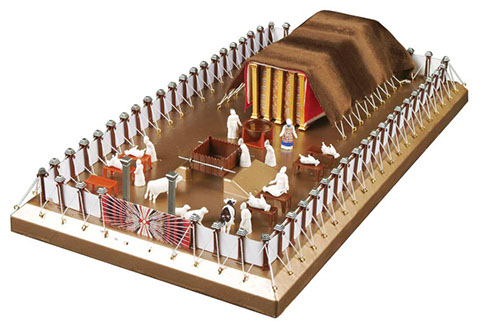
Moses goes up the mountain and receives . . . the instructions for building the Tabernacle!

The Tabernacle of God

There are a few things that always impress me about the building of the Tabernacle:

  • Everything is donated! The Israelite give out of their generosity the finest of treasures. Material, gold, silver, bronze, wood, and on and on the list could go. All of it donated out of the generosity of peoples heart. Later we’ll see that they gave so much, that Moses had to tell them to stop. What a great problem to have.
  • Everything is portable! The entire thing, from tent coverings, to the Altar of Sacrifice, to the Ark of the Covenant, was portable. As the Nation of Israel would move from one location to the other, the Tabernacle would be torn down, packed up, and moved on, leading the what to their next home!
  • Everything is super detailed! God tells Moses the specifics. Length, width, height, material, shape, decoration patterns. It must have been a sight to behold!
  • Everything is covered in blood! Ok, well not everything, but pretty close. We aren’t talking horror scenes from a movie or anything like that, but there is blood none the less. Sprinkled, splattered, spread with a thumb, on everything from the priest’ garments, to the horns of the Altar and everywhere in between. For me, it’s one of those traditions that I’m glad we don’t keep any longer. Not sure I’d want to be the one wearing vestments covered in blood, or the one required to do the splattering

Pressing on to see how the book of Exodus comes to an end. Read with me chapters 30-32.

Peace & Hope you are staying warm!
Pastor Bailey

Year of Scripture – Day 25

Exodus 22 – Exodus 24

I made an interesting observation while reading through this passage. Typically, we think of Moses on the top of Mount Sinai, chisel in hand, recording every word that God has given. This isn’t necessarily the case, at least not as I read things last night. In chapter 24, Moses is “called up” to the mountain, and given the two stone tablets (24:12). Not quite the image that most of us hold on to.

Same could be said about the tablets themselves. Typically, we think of them having the Ten Commandments on them. Nothing more, nothing less. Here again, in my reading, I am led to think differently, as the implication is that God gives the tablets with the law and the commandments. That being the case, all the odd and various laws of the last several chapters would have been recorded as well. Never really thought of it that way.

Lastly, the point of all the laws? (My wife and I had a good laugh as we ready thought a few of them!) Rhyme and Reason. Respect and Order. All of these would be a simple answer, but I would like to think there is a bit more to it than that. Think back with me to chapter 18, when Jethro and Moses are reunited after the Exodus. One of the suggestions Moses receives from his father-in-law is to establish various judges over the people so that Moses was not overwhelmed by case after case. Now, with God’s divide guidance and laws given, the judges could rule justly from one case to another. What a gift!

Now if only I could avoid boiling a kid in it’s mother’s milk (23:19b)!!! I hope you chuckled at that one, I did!

Peace,
Pastor Bailey