All posts by pastorcbailey

Easter Sunday

It was an Easter to remember!

From the Gospel of St. Matthew:

After the sabbath, as the first day of the week was dawning, Mary Magdalene and the other Mary went to see the tomb. And suddenly there was a great earthquake; for an angel of the Lord, descending from heaven, came and rolled back the stone and sat on it. His appearance was like lightning, and his clothing white as snow. For fear of him the guards shook and became like dead men. But the angel said to the women, “Do not be afraid; I know that you are looking for Jesus who was crucified. He is not here; for he has been raised, as he said. Come, see the place where he lay. Then go quickly and tell his disciples, ‘He has been raised from the dead, and indeed he is going ahead of you to Galilee; there you will see him.’ This is my message for you.” So they left the tomb quickly with fear and great joy, and ran to tell his disciples. Suddenly Jesus met them and said, “Greetings!” And they came to him, took hold of his feet, and worshiped him. Then Jesus said to them, “Do not be afraid; go and tell my brothers to go to Galilee; there they will see me.”
Matthew 28:1-11

90+ cars gathered for worship

Good News has come to us. Good News that cannot be contained and needs to be shared. Yet how do you share it, when we’ve all be asked to stay home? Well, here at First Lutheran we got creative. Rather than gathering in our own pews, or staying home on and enjoying the comfort of our own couches, we gathered for a parking lot worship service.

Pastor Doug DeVos

Together, three congregations, First Lutheran, First Christian, and Faith United Methodist shared the Good News of our Salvation that Christ is Alive! Pastor Doug DeVos (First Christian) preached about the great “ta da” moment as Jesus appeared before Mary and the disciples. In that moment fear was shattered and hope was born. In the midst of the uncertainties of our world today, that same “ta da” moment is able to shatter our own fears and bring us everlasting Joy.
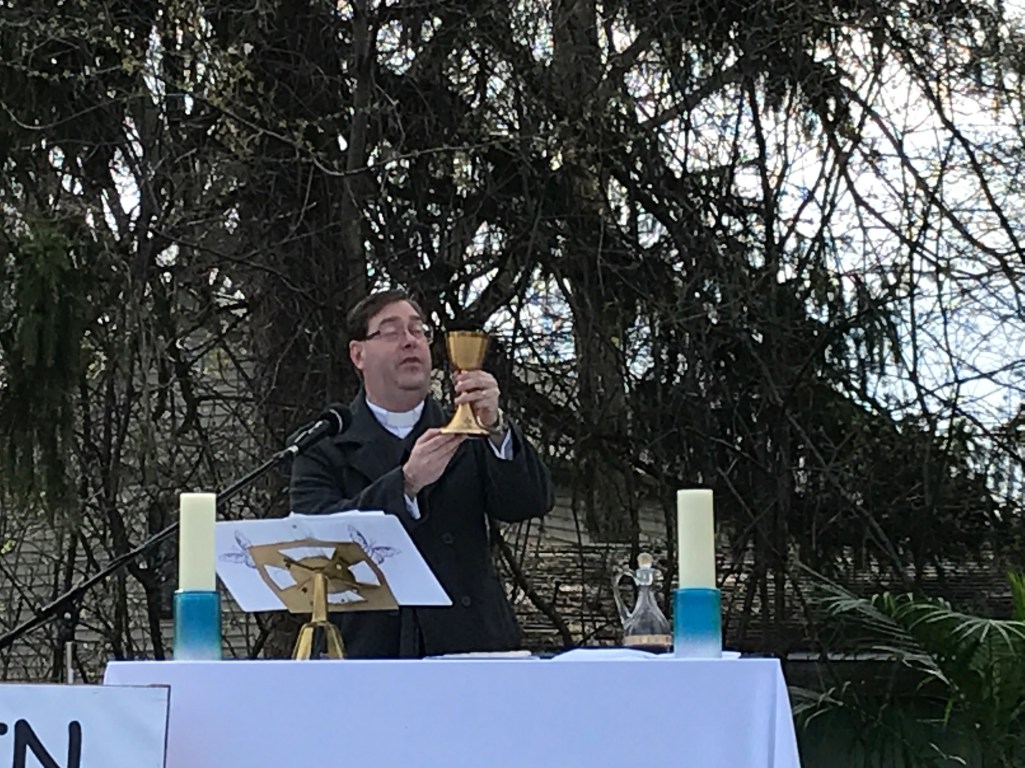
Pastor C.J. Bailey

Filled with joy, we gathered around the Table of Communion with blessings shared by Pastor Marilyn Coney (Faith United Methodist) and Pastor Bailey (First Lutheran). Individuals either brought their own elements or received a presealed communion cup, which included a wafer and grape juice.

The highlight of the day . . . horns honking. As we greeted each other, as we shared the peace, and as we extended many thanks, horns would honk. We may have been separated by windows, government mandates, and arrived from various congregations, but in our worship together we were gathered as one people, a people of God, celebrating the hope that only Christ can bring! While the horns honked here in our own parking lot, somewhere out in the distance, several blocks away, was one horn that would always join in. It was a great reminder that the Good News of the Resurrection is far reaching and continues to be shared today.

Pastors Bailey, Coney, and DeVos sharing the closing blessing.

Maundy Thursday

Exodus 12:1-14
John 13:1-17

Tonight is all about creating new traditions.  New Traditions for the Israelites as they prepare for the Exodus. New Traditions for the disciples as they gather in the upper room on the night Jesus was betrayed. New Traditions for all of us as we continue to adopt/adjust to life with Covid-19.

We are all learning how to live life differently.  We are all learning how to worship “apart . . . yet together.”  I can tell you it is strange leading worship in the absence of a congregation. We are all learning how to fill our time as we are confined to a stay at home order. 

As we are all learning how to live, have you ever though that some of the things we have started doing may very well be new “traditions” that we are creating as we are all spending a bit more time a home. 

New Traditions . . . What do they look like? Well for the Israelites . . . they look like a meal. 

  • Lamb roasted (not boiled)
  • Bread baked (without leaven)
  • Eaten hurriedly.  With rob on and staff in hand.
  • And blood marking the door post so that the angel of Death might simply “pass over”

For God was about to do a new and miraculous thing. God was going to save the people! Too long they had lived in bondage, too long they had been kept from worshiping God, too long they had been oppressed. This was God’s final answer to the continued request that Moses had made . . . “Pharaoh . . . Let my people go”

New traditions were at hand . . . salvation was near.

The same can be said as Jesus gathered with his disciples on the night in which he was betrayed. In the midst of sharing a meal, a bowl was taken out, Jesus undressed and sat on the floor, and he began to wash the feet of his disciples. Then later he took a loaf of bread, he took a cup, he blessed them saying take and eat.

As Jesus took on the role of the servant washing the disciples’ feet, and later as Jesus redefined the Passover meal, he redefines the story of God’s saving act.  For salvation was soon at hand even as the cross grows every closer.

Today, even for us, as the world is being redefined by how we live, work, and interact with one another, New Traditions are being created. But how will those new traditions reflect our life of faith? How will we live out the story of our salvation and reflect the grace, love, and peace that is gifted to us through the life, death, and resurrection of Christ?

I pray that it is through actions of compassion as we seek to love and care for one another!

Palm Sunday

Matthew 21:1-11

“Why can’t we just celebrate Palm Sunday?” That’s a great question to ask as many congregations gather to celebrate “Passion Sunday”, where the text for the day cram all of Holy Week into one day. We’ve got all week to celebrate the Passion, so for today, should Jesus be allowed one day where all the world can praise him.  I believe so, and that being the case, this is it!

As he comes down from Bethphage, as the disciples are sent ahead to bring the donkey and its colt, as Jesus rides through the city gate into Jerusalem, everyone praises him!

Hosanna to the King of kings!
Hosanna to the Lord of lords!
Hosanna         Hosanna         Hosanna in the highest!

This is a day of thanksgiving, this is a day of praise, this is a day worthy of proclaiming.  For as Jesus enters Jerusalem, for once he is recognized for who he is. 

Messiah
Savior
King of kings
Lord of Lords
Son of God.

For that all the people should praise him. For that his name needs to be recognized. For that his name needs to be heard. For that his messages needs to be seen by all the world.

For this is the time when we need to let all the world know that Christ has come . . .

That Christ has come to us, in a time of uncertainties

  • To bring healing to a world plagued by virus and disease
  • To bring hope to a world that seems hopeless, isolated, and alone
  • To bring to life the promise that better things are coming, New restored, resurrection life stands in our future.

Christ has come . . .

  • To show us how to love our neighbors as ourselves.
  • To show us how to forgive as we have been forgiven.
  • To model how we care for one another even as the Samaritan, the outcast, offered care to a stranger in need. 

Indeed, Christ has come. As he rides on in majesty, we realize that this day . . . in fact every day . . . is his day. 

And so with all the crowds gathered along the city street, with the rocks and stones that could not keep silent, with all the earth, with all of the heavenly host we praise his name saying:

Hosanna to the Son of David!
Hosanna in the highest!
Blessed is the one who comes in the name of the Lord!
Hosanna         Hosanna         Hosanna in the highest!

The Hammer & Nails

Matthew 27: 27-54

On this fourth Sunday in Lent, I would like you to ponder a quick question . . . how many nails played a part of the Crucifixion? Think about that just for a moment. 

Most of us are going to say 3 . . . and three might be correct. It is the traditional image of Jesus, arms outstretched with one nail in each hand, feet crossed with one nail driven through each foot. That would make a total of three.

However, some of us might say 4 . . . and most scholars believe that might be a bit more historically actuate. Arms outstretched with one nail thorough each wrist. Then one nail for either foot, through the side of the heal, into the side of the cross, almost in the pose of riding a bicycle. This would have heightened the pain, as the nail went though the bone, and severed the major nerve that runs through the foot and leg.

But a few of us might even say 5 . . . and five you might think?  Yes five . . . that is probably closer to the right answer. Two in his hands. Two in his feet. One for the sign nailed above his head. That sign, often forgotten is still important.   It’s message is still crucial to the crucifixion . . .  so that nail still counts, making a total of five nails.

And those five nails . . . tell a story as well. Just as the Crown of Thorns told the story, of how Jesus’ death is connected to the Garden of Eden and the sins of all humanity.

The nails tell another story . . . They tell a story that reminds us of who Jesus is and why he came.  For what shape can you make with those five nails? Laying them out one by one? Interweaving them one over another? Maybe you’d get something like . . . a star.

33 years before Jesus was hung on the tree, there was a symbol of hope that lit up the night sky.  It beckoned the shepherds. It guided the magi. It accompanied the angels.  As that bright light shone down on all the earth hope was born.

As Jesus came into the world, he was placed into the hands of a carpenter.  Joseph . . . Jesus’ earthly father, and with that we can imaging that Jesus was a carpenter as well. Following in dad’s workshop, following in his father’s footsteps, with hammer and nails in hand, covered in sawdust.  Splinters in his fingers, and blackened fingernails nails from missing the mark. 

Jesus was a carpenter destined for the cross, which means from birth to death . . . nails were a part of his story.

The Crown of Thorns

Matthew 27:11-31

As we’ve reflected on the Pieces of the Passion in our LEGO Lent, so far our stories haven’t had any physical implication. Sure, Jesus spoke of the coming torture of the cross. Sure, Jesus felt the sting of pain as Judas kissed his teacher and friend, betraying our Lord. But now there are physical consequences, as the Crown of Thorns is placed upon Jesus’ head.

Can you imagine . . . .

  • The discomfort . . . as those first few spars began to tug on his hair?
  • The pressure . . . as it was forced snuggly on his head?
  • The pain . . . as the thorns began to cut into his skin?
  • The searing agony . . . as they embedded into his scalp?

What rightfully should have been a crown of glory, what should have been a crown made of the purest of gold, what should have been a crown covered in the rarest of gems, what should have been a crown fitting for the King of kings and our Lord of lords, what should have been is a far cry from the vines of the brier patch that are now weaved into a crown of mockery. 

But why thorns? 

From the very beginning, when God created the heavens and the earth, back when everything was perfect and beautiful just as God intended, in entered into the world as Adam and Eve ate the forbidden fruit. The eyes of both were opened. Now they realized they were naked and afraid. Fear and anxiety crept in.  The unknown stood before them.  It was the world’s first pandemic and we have been battling it ever since.

As God approached Adam and Eve hiding in the brush, asking the question:  “Where are you, What have you done?” With one excuse after the other, God listens . . . then God condemns:

  • Eve with painful childbirth.
  • Adam with the toil of heavy labor and hard work
  • The serpent to crawl on his belly being despised by all mankind
  • And the ground . . .

 We don’t often think of the ground as being condemned, but the very earth that bore to life the Tree of Knowledge of Good and Evil is condemned: God says: “cursed is the ground because of you; in toil you shall eat of it all the days of your life; thorns and thistles it shall bring forth for you.” Genesis 3:17-18

These thorns and thistles, woven into a crown are a reminder of the sin once committed by Adam and Eve.  The same sin that you and I find ourselves in bondage to day after day.  Thousands of centuries after the banishment from the Garden of Eden, the sin and Adam and Eve, take the form of a crown, and are carried to the cross on our behalf.

Judas' Betrayal

We move into the Second Week of Lent and our LEGO Lent takes us to the Betrayal of Judas. There will always be questions of why? Or the pondering of what Judas did it for? Obviously there was the price of 30 pieces of silver exchanged, but beyond that, what was Judas thinking?

United Methodist Pastor, Tim Smith wrote in a Sermon from 2013 (yes it is always good to read what others are preaching) that there are three distinct reasons why Judas may have become the betrayer.

  1. Greed:  Which makes sense. Hearing the story from Matthew 26:6-16 where Jesus is visiting the house of Simon the Leper in Bethany. As the jar of ointment is broken and poured over Jesus, Judas becomes very vocal: “Why this waste? For this ointment could have been sold for a large sum, and the money given to the poor.”
  2. Fear:  On multiple occasions, Jesus has said to his Disciples that they will experience the same fate.  Jesus has spoken openly about the Cross.  We know that it’s coming. Yet to the disciples this is scary, and according to Jesus it may likely be their fate as well.  Perhaps, Judas may have thought, “If Jesus is out of the way . . . then we don’t have to worry about that type of fate.”
  3. Rebellion:  There are many who believe that Judas wasn’t content with this peaceful, loving Jesus.  He wanted rebellion.  Even his name, might lead us to believe that as Judas Iscariot may have been one of the Sicarii.  This was a fanatical group of nationalist who wanted to free Israel from the oppression and rule of the Romans.  Think terrorist in our own day in age. With that mind set, Jesus wasn’t living up to his promise of new life and freedom, so Judas did what was natural to him. He rebelled.

Whatever the reason might be.  There is the Garden of Gethsemane, just after Jesus had finished praying . . . the deed was done. With one Kiss, Jesus was betrayed and handed over to the chief priest. The Crucifixion was now close at hand.

As we journey through our LEGO Lent, we recall God’s obedience to the cross by adding one small brick to our story broad. LEGO money . . . as a reminder of Judas’ betrayal and the 30 silver coins offered to Judas by the Pharisees.

Blessed Lent!
Pastor Bailey

Week Two of LEGO Lent

Lent Begins

This year as we begin our journey to the Cross of Christ I can say that I am excited about Lent. Seems odd to say, but it’s true this year I’m excited about the walk to the Cross! I hope that you can share my enthusiasm as we are taking on a special theme for our Sunday Morning Worship Services. Perhaps as we gather to worship it will take you back to your childhood, I know it does for me, as we set out to reflect on LEGO Lent.

Yes that is right, those tiny LEGO bricks have found their way into our worship service as each week a few blocks will help tell the story of Jesus’ Passion and Death. Following worship, you’ll even receive your very own bricks to build your own “mini-kit” to help you remember the great love that Jesus has for you.

This week . . . the Cross.

Long before Holy Week begins, Jesus speaks of his death on the cross. It’s a fitting place to start as we begin our walk toward Good Friday and the glories of Easter. I hope you can make it join us for worship. If not, be sure to listen in on our Worship tab for each week’s message and how LEGO Lent reveals how LEGOS Explain God’s Obedience to the Cross.

Year of Scripture – James

Reading for:
Day 355 – Saturday, December 21

As a Lutheran Pastor, I’ve got to deal with the obvious . . . If you know anything about Martin Luther, than you have probably heard that Luther commonly called James “the epistle of straw.” Luther didn’t like James. He didn’t feel it was worthy of being included in the Bible. He disagreed with it’s theology, and thought it was rather pointless of a reading/writing.

Why would Luther feel such a way?

The simple answer revolves around the three “Sola’s”. These Latin pharases, “Sola Scriptura”, “Sola Gratia”, and “Sola Fide” translate accordingly to by Scripture Alone, by Grace Alone, and by Faith Alone.” For many these three statements define the heart and mind of Luther, and it certainly reflects well Paul’s words to the Ephesians, “You are saved by grace through faith.” However, James challenges that thought process by including this little thing called “works.”

“What good is it, my brothers and sisters, if you say you have faith but do not have works? Can faith save you? If a brother or sister is naked and lacks daily food, and one of you says to them, “Go in peace; keep warm and eat your fill,” and yet you do not supply their bodily needs, what is the good of that? So faith by itself, if it has no works, is dead.”
(James 2:14-17)

You can see where one may struggle with this. However lets be clear, works alone do not provide the means to salvation. Only Jesus can do that! This is where Luther struggled with James. However, I believe James makes a valid point, works are important, because they are an expression of our faith. If we are living out our baptismal covenant, Faith calls us to action to care for the least of these. That is our “work” as James would remind us. Simply saying “I believe” is not enough, but sharing our faith in our actions and care for one another is our moral obligation as followers of Jesus Christ.

So lets get to work in the name of Christ!

Peace,
Pastor Bailey

Year of Scripture – Hebrews

Readings for:
Day 352 – Wednesday, December 18: Hebrews 1 – 6
Day 353 – Thursday, December 19: Hebrews 7 – 10
Day 354 – Friday, December 20: Hebrews 11 – 13

I can hear Harriet say, “Now Pastor, you know the Bible is very clear on who is supposed to make the morning coffee!” “It is?” I would reply and she would start laughing. “Of course, it does . . . He – Brews!”

Harriet was a beloved church lady at my last call in Palm Beach Gardens, Florida, and she was always full of whit and humor. Yet always filled with a deep and sincere passion for our Lord. Unfortunate for me, but a blessing for her, God called her home while I was serving there and we had a wonderful celebration of life, filled in with her whit and humor.

As I think of Harriet and her passion, Hebrews comes to mind as it is full of passion and love for our Lord and Savior Jesus Christ. From its opening words:

“Long ago, God spoke to our ancestors in many and various ways by the prophets, but in these last days he as spoke to us bay a Son!”
(Hebrews 1:1-2a)

Much like the eloquent words to the beginning of the Gospel of John, the unknown author writes beautiful words that connect Jesus Christ, to the ancient of days through the Order of Melchizedek. Now you may be asking, “who is that?” Over and over again, the Letter to the Hebrews refers back to this peculiar named priest, but know this isn’t the first time we’ve heard his name. Look back with me to Genesis 14:

Then Melchizedek king of Salem brought out bread and wine. He was priest of God Most High, 19 and he blessed Abram, saying,

And King Melchizedek of Salem brought out bread and wine;
he was priest of God Most High. He blessed him and said:
“Blessed be Abram by God Most High, Creator of heaven and earth.
And praise be to God Most High, who delivered your enemies into your hand.”
(Genesis 14-18-20)

Long ago . . . Hebrews starts out, and we are connected to the first priest of God. Little mentioned. Little reflected upon. Still important to the story as Abram is blessed by God through Melchizedek. A blessing that is then poured out to us through Christ who is the completion of the line of priest. Christ is the perfection of everything God created, and through the cross we are forever united into the priesthood of all believers.

I know it’s complicated. Still it’s beautiful!

Peace,
Pastor Bailey

Year of Scripture – Philemon

Reading for:
Day 351 – Tuesday, December 17: Philemon

There is no way to skirt around this. There is no hiding the obvious. There is no easy way to hide the fact that in order to read and understand Philemon we are going to have to deal with slavery.

Now that that is out of the way, let me add, I am not a proponent of slavery. It is an unfortunate dark stain in the history of our country, and a horrible reflection of the world especially in our ability to mutually care and respect one another. It saddens me that in some circles and black markets of the world slavery and indentured servant-hood still exists. As a basic God given gift, we were all created equal in God’s image, and we all should be working hard to end what should have ended years ago.

That being said, in order to understand Paul’s urgency in writing Philemon, we have to ask the question, “If you were a slave owner, and one of your slaves ran away, who may have physically stolen or harmed you in some way shape or form in their flight, what would you do upon their return?” Not an easy question to ask. Not an easy question an answer, and chances are if we were going to answer truthfully, we probably wouldn’t be overly kind to them upon their return.

With that mindset, we now insert Paul’s letter. Treat him as a “beloved brother” (v. 16) for I have become like a “father” (v. 10) to him, and he is one with us “in the flesh and in the Lord.” (v. 16) Ahh . . . great words. You can only wonder if they worked. I pray that Onesimus was welcomed as warmly as Paul encourages Philemon to act. Paul then goes on to promise to repay Philemon for any “wrongs” that Onesimus has done, and to ready a guest room for Paul is soon to visit.

For me, this is one of those letters that makes you want more. What happened next? What is the story beyond the story? We do know that Onesimus plays a roll throughout Paul’s travels and is referred to several different times. So he’s a key part of the growth of the early church. More importantly, this letter reminds us, that we are all created one in the eyes of God. We are all called to treat one another as sisters and brothers in faith. As Paul writes in Galatians, no longer are we defined as slave or free, male or female, young or old. Or as the children’s song would have us sing, “red, yellow, black, white, we are precious in his sight. Jesus loves the little children of the world.”

Even as we begin a new year, may you remember to love all God’s children, as God loves us!

Peace,
Pastor Bailey